


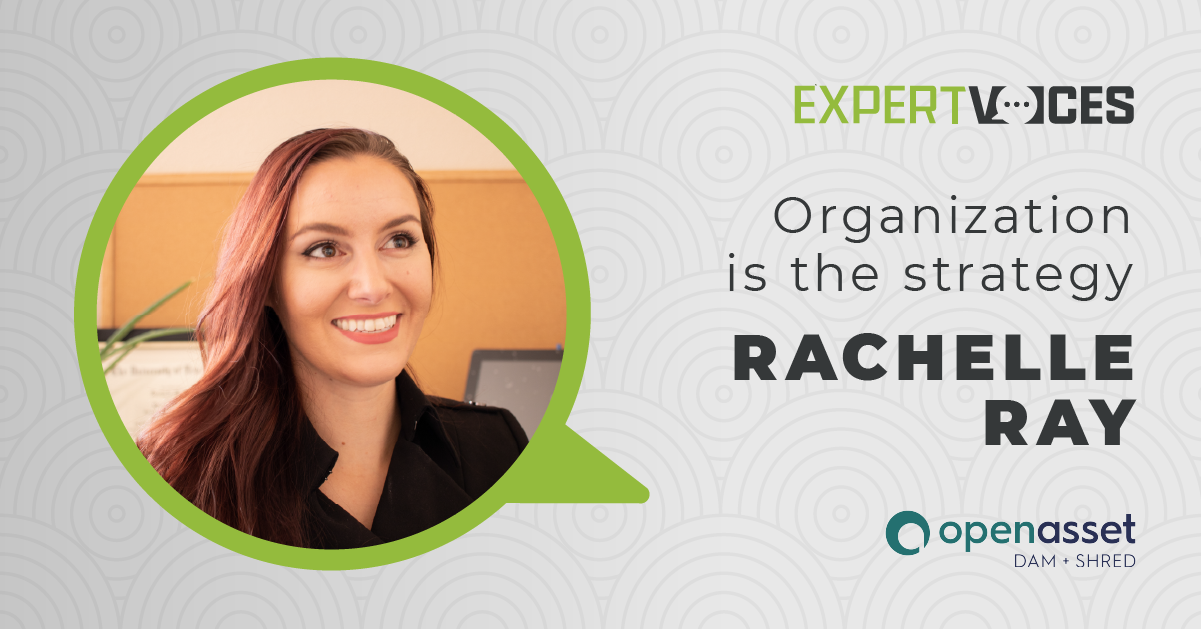
Expert Voices: AEC Marketing Organization with AI
Conversation with Rachelle Ray
Early in her career, Rachelle Ray found herself assembling printed proposal packages when a newly hired marketing director walked out and began marking up a submission that was supposedly ready to go. Project information flagged. Content still unverified. Deadline bearing down.
“That is day-to-day disorganization compounded at the finish line,” she says. “It is uncertainty about, and a lack of confidence in, the data in our documents.”
Rachelle is now Head of AEC Marketing Innovation at OpenAsset. She has spent her career helping AEC firms untangle the content chaos that slows proposal teams down, and she’ll tell you the tools have changed. The underlying problem has not.
The Hidden Cost of Chaos
Today’s proposal teams may not be assembling binders around a conference table, but many still spend valuable hours searching for information before proposal development can even begin.
Project descriptions. Final construction costs. Updated resumes. Headshots. Photography. The work looks productive from the outside, but much of it is simply retrieval. According to Rachelle, firms routinely underestimate the true cost of that disorganization.
A significant portion of early pursuit production time is consumed just locating what already exists.
Firms don’t track retrieval as waste, so it never gets addressed. The hours disappear, and with them the time that should be going toward win theme development, competitive differentiation, and making sure the submission actually reflects the firm’s best work.
The impact extends beyond productivity. When talented marketers spend their days searching through folders, emails, and outdated files, frustration and burnout follow. Turnover in AEC marketing is real, and the chaos of these environments is a bigger driver than most firm leaders acknowledge.
When Firms Reach a Breaking Point
Most firms don’t decide to improve marketing organization because they’re excited about content governance. Change comes after a costly mistake, a key employee departure, or a realization that their content isn’t ready for AI. Increasingly, that last trigger is becoming the deciding one.
“The AI conversation is doing in one quarter what years of internal advocacy couldn’t,” Rachelle says.
As firm leaders explore AI-powered proposal tools, many are discovering an uncomfortable truth: when project data is scattered, resumes are outdated, and content lives in multiple locations, AI doesn’t solve the problem. It accelerates it. Garbage in, garbage out—and in a proposal context, that can mean misrepresented credentials, inaccurate project costs, or scope language that finds its way into a contract.
Governance Before Technology
When asked where firms should start, Rachelle’s answer is direct: don’t start with software. Start with governance.
Establish a single source of truth for project information and create clear ownership for maintaining it. She learned this lesson early in her career after repeatedly pulling outdated information from old proposals. The solution wasn’t sophisticated: a large spreadsheet that the team committed to maintaining together. It changed what the firm could rely on.
Resume management deserves the same discipline. Without clear ownership and an approved version for each person, proposal teams spend hours recreating information that already exists. Fix the governance before you fix the software.
Building a Foundation for AI
As firms grow, shared drives become harder to manage and institutional knowledge harder to access. A quality signal worth watching: when proposals go out with outdated renderings, low-resolution photography, or incorrect project costs, that’s rarely a people problem. It’s a system problem. The right asset wasn’t findable.
Rachelle describes the historical library as a fossil record: a layered archive of how your firm has talked about its work over time. It’s where you go for narrative inspiration—past project descriptions, win themes, technical approaches from previous pursuits. Like any fossil record, it tells you what existed at a specific point in time. Your current resumes, approved firm bio, and final project costs lived there once, but they’ve since been superseded.
For what’s true right now, you need the asset library: current resumes, verified final project costs, confirmed team credits, approved firm bio, and up-to-date photography. You pull narrative from the fossil record. You verify facts against the asset library. When firms conflate the two, or have neither, the data in their proposals reflects whatever someone found first, not what’s accurate.
Build the content foundation first. Then introduce AI as an acceleration layer on top of that foundation, not as a substitute for it.
The firms seeing the greatest success with AI aren’t using it to generate expertise from thin air. They’re using it to surface, organize, and deploy the expertise they’ve already built, on a foundation of content they trust.
Organization Is a Leadership Decision
If there’s one message Rachelle wishes every AEC leader understood, it’s that marketing organization is not a software problem. It’s a leadership decision—one that has been deferred for years because it feels less urgent than a project that’s over budget or a client who just called.
Many firms have done genuinely impressive work: complex projects, long client relationships, hard-won expertise that competitors can’t replicate. None of it works for you in a pursuit if your team can’t get to it when the RFP lands.
The firms that consistently win more work aren’t always the most talented. They’re often the most organized.
As firms race to adopt AI and emerging technology, the advantage may not belong to those moving fastest. It may belong to the firms that first build confidence in the content, data, and institutional knowledge that powers every pursuit.

Leave a comment: